


This case study describes how Softray supported secure platform development, system integration, and interoperability for a nationwide distance-based tolling ecosystem.
Client Overview and Challenge
Client: European ITS / Tolling Operator
Product: Truck Tolling System
Industry: Transportation / Intelligent Transport Systems (ITS)
Technologies: Java, Spring Boot, Kafka, Cloud AWS, SOAP, RabbitMQ, SQL
The project is part of the Dutch national truck tolling initiative, a government-regulated program introducing distance-based charging for heavy goods vehicles on Dutch motorways and selected regional roads.
The system introduces a distance-based tolling model in which truck owners are charged per kilometer driven. To support this model, every truck must be equipped with a certified on-board unit (OBU), enabling accurate tracking, reporting, and enforcement of toll trips across the national road network.
The ecosystem involves multiple certified stakeholders, including OBU service providers, tolling operators, customer support systems, pickup and drop-off logistics, and national authority systems, all operating under strict regulatory and interoperability requirements.
Softray’s team contributed to critical platform components that enable this ecosystem, including customer onboarding, OBU lifecycle management, toll trip collection, secure communication, and billing data exchange.
For tolling operators, the challenge is not only launching new functionality, but ensuring that customer onboarding, device management, trip collection, billing data, and authority-facing integrations work reliably across a regulated ecosystem where every failure can affect revenue, compliance, and public trust.
Given the nationwide impact, strict regulatory framework, and fixed go-live deadline, delivering a reliable, secure, and fully interoperable solution has been essential.
Key Challenges and Goals
The implementation of a nationwide tolling system introduced complex technical, operational, and regulatory challenges requiring tight coordination across multiple systems and stakeholders.
- End-to-End Customer and Device Lifecycle: Enable seamless customer registration, postpaid and prepaid accounts, automatic and manual payments, customer communication, and full OBU lifecycle management from delivery and personalization to activation, status tracking, reassignment, termination, return, and refund.
- Complex Multi-System Integration: Integrate with certified OBU providers, national authority systems, customer service CRM, and pickup/drop-off logistics while managing dependencies across regulated and certified external systems.
- Secure and Compliant Communication: Establish secure communication across all integrations, implement key management and exchange mechanisms, protect sensitive and payment-related data, and meet strict auditability requirements for national tolling infrastructure.
- Operational Readiness for Nationwide Rollout: Align multiple systems and stakeholders under strict timelines, ensure data consistency across the ecosystem, support scalability for nationwide adoption, and prepare integrated services for certification and launch readiness.
Solution and Approach
Softray contributed through platform development, system integration, and secure communication implementation, supporting reliable operation across a complex, regulated tolling ecosystem.
Customer Onboarding and OBU Lifecycle Management
The team supported the full customer and device lifecycle, including:
- Customer registration and onboarding processes
- Association of customers, contracts, vehicles, and OBUs
- Coordination of OBU delivery to end users
- OBU personalization and activation
- Ongoing device lifecycle management and status tracking
- Contract termination and OBU return and refund
- Reporting of defective, lost and stolen OBU
- OBU reassignment to different vehicles
This ensured a smooth experience from initial registration to active participation in the national tolling system.
Integration with Certified OBU Provider
A key part of the solution was enabling robust integration with a certified OBU service provider. The team implemented and supported functionalities, including:
- OBU activation, personalization, and depersonalization
- Device status management (lock/unlock operations)
- Collection of toll trip data from OBUs
- Handling of evidence data associated with toll transactions
This ensured that all driving activity is accurately captured, validated, and securely transmitted for downstream processing.
Integration with National Authority Systems
To support billing, enforcement, and regulatory compliance, the platform integrates with national authority systems through standardized interoperability processes defined by the national tolling program. The team contributed to the implementation and stabilization of flows such as:
- Billing details
- Payment announcements
- Toll declaration processing
- User details requests
- Exception list (whitelists and blacklists)
- EFC context data exchange
These integrations ensure that toll trips are correctly validated, processed, and billed in accordance with national regulations.
CRM and Pickup/Drop-Off Logistics Integrations
The platform also supports customer service and logistics workflows through integrations with external CRM and pickup/drop-off systems. These flows help customer support teams manage user inquiries, enable OBU ordering and pickup, and keep operational data synchronized across the tolling ecosystem.
Secure Communication and Key Management
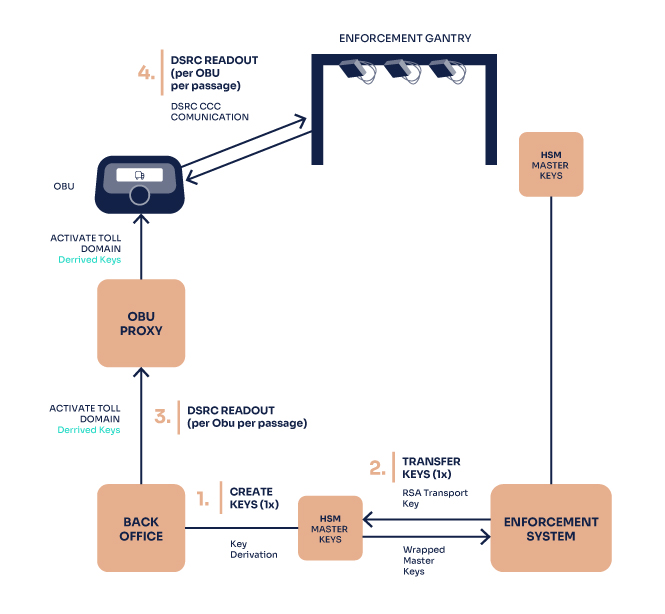
Security is foundational because tolling infrastructure exchanges sensitive vehicle, financial, and trip-related data. The team contributed to a DSRC-based security model aligned with ISO 14906 and EN 15509, supporting secure OBU-to-gantry communication through access keys, authentication keys, encrypted key distribution, and controlled key lifecycle management.
- Access keys are used to read and write OBU data, while authentication keys are used to sign and verify sensitive data.
- The project supports Level 1 security, which combines access and authentication requirements.
- Keys are derived from master keys and dynamic OBU-specific attributes, helping ensure unique, non-reusable cryptographic credentials.
- Secure key generation, transport, and non-exportable key enforcement reduce exposure of sensitive cryptographic material.
This approach helps ensure that OBU-to-roadside communication is authenticated, tamper-resistant, and compliant with strict regulatory and interoperability requirements.
Results and Benefits
The delivered work strengthened production readiness across a complex, multi-stakeholder tolling ecosystem, improving the reliability and consistency of interactions between external providers, national authority systems, and internal platform components.
- Stronger interoperability: By stabilizing critical integrations and reducing dependency-related failures, the platform supports uninterrupted data exchange and minimizes operational friction across certified systems.
- Reduced integration risk: Standardized interface implementation and close coordination with external stakeholders improved readiness in a regulated environment where compliance and certification requirements are mandatory.
- Improved security posture: DSRC-based communication and structured key management established a high level of trust across participating systems, with sensitive data exchanges protected, auditable, and aligned with industry standards.
- Higher tolling data accuracy: Improvements in toll trip collection and validation support reliable billing, enforcement, and reporting processes, including complex pricing models based on vehicle characteristics such as weight and CO2 emissions.
- Greater rollout readiness: Through continuous stabilization, certification alignment, and close coordination across stakeholders, the solution reduced delivery risk and supported readiness for a fixed regulatory go-live deadline.
Overall, Softray’s contribution strengthened the platform’s reliability, security, and interoperability, supporting readiness for the deployment of a mission-critical national infrastructure system.
Why It Matters
Nationwide tolling systems depend on more than individual features. They require trusted integrations, secure data exchange, operational discipline, and platform components that can hold up under regulatory pressure. This case study reflects the kind of complex engineering environment where Softray’s delivery teams bring the most value: high-stakes systems, many moving parts, and no room for fragile execution.
At Softray, we build and modernize platforms that must stay reliable under high pressure, especially where compliance and continuity are non-negotiable.
Let’s build with care and design for impact.
Source note: Case study prepared based on Softray project documentation. Third-party names have been generalized to preserve client anonymity for website publication.